


by Phil Hanford, on May 29, 2026 at 6:00 AM
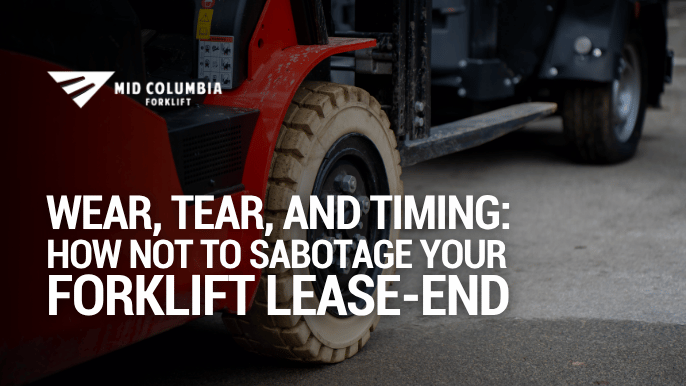
We protect operators from repetitive stress injuries, but what about the forklifts themselves?
Both machines and human bodies wear out over time. Likewise, they age faster when subjected to frequent strain. Runners tear up their knees. Forklifts rip up their tires. Care and regular maintenance minimize the damage, but eventually, it adds up.
For a forklift, that can mean a nasty shock at lease-end.
Many fleet managers shrug off minor damage as normal wear and tear. One ding might not be a big deal, but damage compounds over the course of a forklift lease. If you don’t plan for it, it could be a heavy hit to your budget.
Read on for our 12-month checklist to prepare for the end of your forklift lease.
Your Simple Forklift Lease-End Checklist
We encourage everyone to start lease-end planning one year out.
However, depending on the condition of your forklift, lease-end preparations could take as little as eight months. Still, that’s a tight timeline. We don’t recommend making it your first choice.
Whatever your timeline, start your preparations by addressing these critical areas as soon as possible.
1. Your Lease-End Timeline
Confirm your lease terms.
Leases vary, and guessing could cost you big. Double-check the following:
- Lease-end date
- Any applicable notice requirements
- Lead times for replacement equipment
These terms solidify your timeline and provide important deadlines.
Without this information, you risk violating your lease agreement or stumbling into a significant penalty.
2. Safety Features
Next, focus on repairs.
Fixing up a well-used forklift is much less expensive than turning over a battered truck. Start with safety repairs. These are usually quick fixes that can save you a lot of money. At a minimum, make necessary repairs to ensure:
- Seatbelts are present and functional
- Lights and strobes work
- Horn works
- Backup alarm activates
- Parking brake functions
- Data plate is readable
- Overhead guard is intact
Any safety repairs you make will pay off at lease-end.
These are especially important if you’re low on time.
3. Tires and Traction
Forklift tires take a beating.
Worn-out tires will cost you big at the end of your lease. Addressing them early protects you from surprise charges and helps avoid other damage. Start by:
- Checking the tread for cracks and chunking
- Inspecting for uneven wear patterns
- Confirming the forklift has the correct tires for its application
- Noting any damage from debris or impacts
Prioritize these repairs. It’s often less expensive to install new tires than to let your lease end with chewed-up ones.
Tires are a common trouble spot and a frequent source of repair charges at the end of a contract.
4. Leaks, Damage, and Annoyances
Compounding small problems are more expensive than the sum of their parts.
Conduct a thorough forklift inspection and create a general repair punch list. Focus on the minor repairs you’ve been putting off. Check for:
- Visible leaks
- Bent forks
- Mast wear
- Sloppy chains
- Cracked hoses
- Broken guards, panels, and covers
- Broken gauges
- Inoperable lights
Targeting small repairs improves ROI. These issues are frequently inexpensive to fix, saving you money compared to the associated penalty. Keep this in mind while you create your punch list. Some repair costs might be comparable to the penalty, making them less cost-effective to repair yourself.
Reference your lease terms when completing this cost-benefit analysis.
5. Forklift Battery and Charging Habits
Forklift batteries are another area worth attention.
Obviously, batteries and chargers are vital components for electric forklifts. Consequently, damaged or inoperable batteries get expensive at lease-end. Address battery and charging issues as early as you can. Evaluate the following:
- Battery age compared to expected lifespan
- Watering and equalizing routines
- Charger health
- Connector condition
- Signs of heat damage
- Corrosion levels
- Recurring low-voltage issues
Tackling these a year out can prevent significant damage, potentially preserving existing batteries through lease-end. If you must invest in replacement batteries or charger repair, correcting bad habits keeps you from paying for the same repair twice.
Although we present these five steps in sequence, you can complete many of them simultaneously. For example, don’t wait to fix poor battery maintenance just because new tires are on back order.
Instead, think of the numerical order as the order of priority. It’s best to address them all, but if you can’t, focus on the highest priority items for the best ROI.
Forklift Lease-End Action Plan
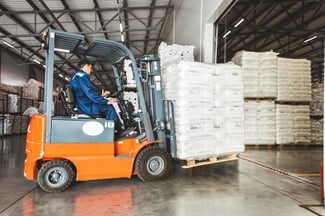 While there are five top priorities, each has several parts.
Don’t try to cram them all into the same month. That’s unsustainable. Instead, we recommend the following cadence.
12 Months Out
- Read the hour meter
- Complete a quick, preliminary inspection for most forklifts
- Complete a thorough inspection for forklifts working in harsh conditions
- Schedule a check-in call with our team to road map the next 12 months
10 Months Out
- Decide whether you plan to replace your unit, purchase it, or extend your lease
- For replacements, start planning with our team to select a new model and check availability timelines
8 Months Out
- Schedule an on-site condition review with our team to identify key repairs
- Complete all target repairs
6 Months Out
- Finalize your continuation plan (replace, keep, or extend)
- For replacements, align delivery and operator training
90 Days Out
- Double-check your action plan to find any missed details or last-minute adjustments
- Schedule a final check-in call to prevent any final surprises
This pacing will ensure you hit all your targets without overwhelming you or your team.
How To Tackle Extreme Wear and Tear
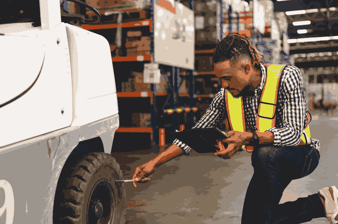 Forklifts working in harsh conditions wear out faster.
Premature wear means you should start preparing for lease-end earlier than you might otherwise. If your forklift works in any of these conditions, you need to plan for lease-end at least 12 months out:
- Extreme weather
- Rough yards
- Cold storage
- Corrosive environments
- Dusty areas
- High-impact areas
For these forklifts, lead time is critical. Extensive wear typically means more repairs are needed prior to lease-end. Assume 12 months is the minimum time you need to prepare.
It’s far better to have time you don’t need than to need time you don’t have.
Get ahead of the curve by scheduling your check-in now. Even if you have more than 12 months left on your lease, a check-in will help you develop an achievable timeline framed around a realistic assessment of your forklift’s condition.
When in doubt, reach out.
Regardless of your forklift’s condition, it’s never too early to get proactive about your lease. Our expert team will walk you through the process, cover all your options, and advise you on the most cost-effective step forward. Don’t let lease-end sneak up on you. Start planning your next steps today.
To learn more about forklift lease options or lease-end planning, contact us online or visit one of our locations.
Auburn 253-854-5438
Pasco 509-547-7413
Wenatchee 509-663-9009
Yakima 509-457-5137
Further Reading
Forklift Lease End Options: Replace It, Keep It, or Extend It
When Leasing a Forklift Makes Sense
Forklift Purchasing Options: Buy, Lease, or Rent