


by Phil Hanford, on May 15, 2026 at 7:00 AM
Did you know that running shoes should be replaced every 300 to 500 miles?
Usage determines lifespan. A competitive runner will wear out their shoes faster than a jogger who runs twice a week. That same common sense applies to your forklift. Operational hours determine the fate of your forklift, which is why lease terms limit hours.
It’s also why you should check your hour meter first if your forklift lease ends this year.
Most people aren't sure what to do when a forklift lease ends. Buy a new one? Keep this one? Just... return it and figure it out? The hour meter cuts through that uncertainty. It tells you what's next for your forklift, how much time you have to act, and how expensive it will be to wait.
Read on to learn how your hour meter informs your forklift’s lease-end plan.
Why the Hour Meter Matters
Forklifts age in hours, not years.
Two forklifts might have the same number of service years, but can be living totally different lives. One truck runs for a light 800 hours a year. Meanwhile, another cranks out a hard 2,500+ hours annually. They will not age the same. A high-hour forklift puts more strain on its components, and that can show up as more service calls, more replacement parts, and more interruptions.
If you’re a year out from lease-end, hours give you a clear picture of your forklift’s future.
A Simple Way To Read Your Hours
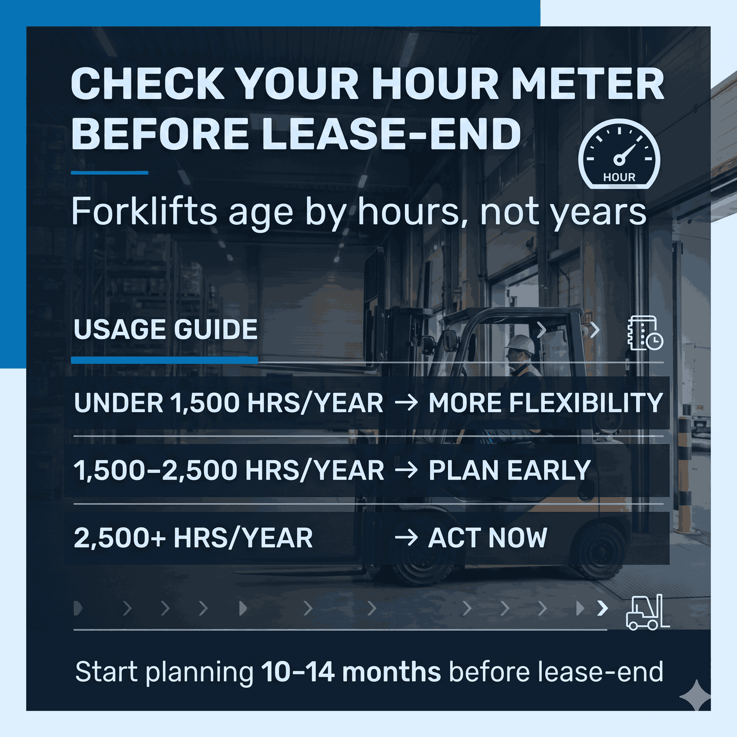
You don't need to be an engineer or a fortune teller to read your unit's future in its hour meter.
Keeping an eye on annual usage helps you stay on top of your forklift’s lease terms and plan accordingly. When tracking hours, use this rule of thumb to determine how quickly you should make lease-end plans:
- Under 1,500 hours per year: You usually have more flexibility.
- Around 1,500 to 2,500 hours per year: Plan early. Your options narrow faster.
- Over 2,500 hours per year: Start now. Waiting will lead to a rushed decision.
This does not replace a professional assessment. Still, it helps you know how urgent the lease-end conversation should be.
Use hours as a guide to plan your timeline and schedule your lease-end check-in appropriately.
Which Hours Matter?
Modern forklifts track tons of data.
Consequently, knowing which hours are important can be difficult. Additionally, hours aren’t calculated the same for every forklift. Follow these guidelines for tracking hours:
- Internal Combustion Forklifts. For IC forklifts, use the key-on hour meter reading.
- Class I Sit-Down Electric Forklifts. These forklifts calculate hours by adding total drive hours to pump hours. However, if the sum of these readings exceeds the key-on hours, use the key-on hours instead.
- Class I Stand-Up Electric Forklifts. The dead-man hour meter is the best option for these models.
- Class II Narrow Aisle Forklifts. The dead-man hour meter is also the best choice for this class.
Not every brand displays hours the same way. So, check your manual to ensure you’re looking at the correct numbers.
The 10-to-14-Month Window
Start evaluating 10 to 14 months before your lease expires.
That runway gives you time to pivot if your hours are running high. It also gives us time to structure the right solution for your specific lease before you're backed into a corner. Starting early is the difference between choosing your path and reacting to it.
When Returning the Truck Isn't the Right Move
Here's a move a lot of people don't consider: if your hours are high, keeping the truck might be smarter than returning it.
For hard-running equipment with 5,000 or more hours, buying out or refinancing the unit can actually make more sense than handing it back. You avoid wear-and-tear penalties. You hold onto a machine you know. There are two ways to get there:
Monthly extensions. Targeted month-to-month payments, typically capped at three, can actively buy down the residual price before you purchase outright. Just make sure your lease terms include additional hours in the extension. If they don't, overtime charges can still add up fast.
Refinancing. Rather than extending month-to-month, you can refinance the unit as a used forklift for an additional year. This typically reduces the residual value significantly, making the final purchase much more affordable.
Either way, these options need to be set up in advance. That's exactly why the 10-to-14-month head start matters.
Before You Call: A Quick Checklist
To get the most out of a lease-end conversation, gather this information first. It takes about 10 minutes and makes the whole call more productive:
- Current hour meter reading
- Make, model, and capacity (example: 5,000 lb electric)
- Battery age (if electric) or engine hours (if IC)
- Where it runs most (dock, aisles, yard, freezer)
- Any recurring issues (hydraulics, brakes, steer axle, mast, electrical)
- Your best guess: keep it, replace it, or not sure
Ten minutes of fact-finding can earn you ten months of lead time.
The Numbers Don't Lie
Every operation is different. But the hour meter doesn't care about your timeline or what you were hoping to hear. It just tells you the truth.
Our team can walk through it with you. We'll review your hours, application, and timeline, then map your best path forward based on data you can trust.
Auburn 253-854-5438
Pasco 509-547-7413
Wenatchee 509-663-9009
Yakima 509-457-5137
Further Reading
Forklift Lease End Options: Replace It, Keep It, or Extend It When Leasing a Forklift Makes Sense
Forklift Purchasing Options: Buy, Lease, or Rent
When Leasing a Forklift Makes Sense